Drought scenes: Pond
Aug. 7th, 2011 06:26 pm![[personal profile]](https://www.dreamwidth.org/img/silk/identity/user.png) neverspent
neverspentI'm back at the farm. I knew the drought in this part of the state was becoming severe, but driving here through the hills almost made me gasp with how obviously bad things have become. I'll probably write more on the general situation later, but this morning I walked down to the pond and saw something I've never witnessed before: our spring-fed pond is almost completely dried up. The spring bubbles out of the ground nearby and flows into the pond, oxygenating and cycling the water before it flows out into a little creek at the other side. Or it has done with basically no human interference for the 29 years we've lived on this place, but now the spring has disappeared. The sight of the cracked mud and stranded lilies and the pathetic, murky pool that remain were a bit of a shock, even though I was prepared.
It's nothing like this lake in Texas or this one in Florida, but the condition of our little pond is a very personal illustration for me of how this disaster affects natural systems.
The view of the pond from the south

...And from the north. Also a "side view" in which you can see a cow trail on the left that defined what used to be the edge of the water.
Here's what most of the water surface looks like.

Pond lilies, algae, and dust. As you can see, the water quality is no longer conducive to many types of pond life. The presence of the thick algae indicates probably the water is very low in oxygen now. It's no longer being stirred and replenished by the spring. There may be a few fish left, but they have to be clumped together in a very small space, choking to death in a few inches of water.

I saw quite a variety of tracks: raccoon, deer, birds, and some smaller creatures; I'm sure that while it lasts this is one of the only reliable places for the local wildlife to drink. There are no more springs or puddles in the woods. The largest animals, the cows and horses, left holes 10 inches deep where their feet almost became mired in the mud. It's a danger that they'll get stuck, and the water quality is so poor anyway, we are using alternate methods to water the horses.

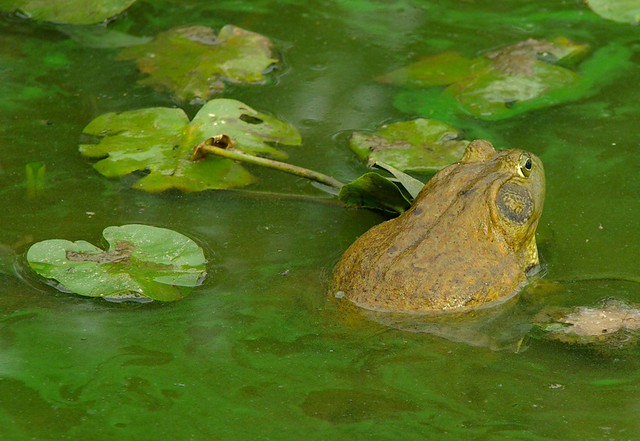
At what used to be the outer edge of the pond, where the ground is hard and dry, there are scores of grasshoppers that scattered when I walked through them. A little further in, where the mud is cracked but still has a little moisture, there are tiny grey frogs that pat away into the wetter mud. And in one place, there was this fellow. I heard a tremendous plop-splash and there he was, half submerged, watching me.

Butterflies, wasps and dragonflies are also taking advantage of the water they can suck up through the mud and algae.

Of course I wondered what we might find in the bottom of the pond in places that had been covered by mud and water for decades. To my mild disappointment but mostly relief, the only things were two mud-encrusted beverage cans, neither of which I recognized as things my family has ever drunk. That makes me think they could have been there for 20 to 30 years. It's a manmade thing, but it shows how long it's been since the pond was this low.


You can see this Tab diet soda can closer here. I don't think you can even buy Tab cola anymore. Wasn't it the first diet soda?
Even though it was an unpleasant surprise to see how things have changed so quickly, it was interesting how some things are still hanging on and taking advantage as well as they can. Bless the frogs and dragonflies and raccoons and birds and waterbugs and anything that can live in green mud.
It's nothing like this lake in Texas or this one in Florida, but the condition of our little pond is a very personal illustration for me of how this disaster affects natural systems.
The view of the pond from the south
...And from the north. Also a "side view" in which you can see a cow trail on the left that defined what used to be the edge of the water.
Here's what most of the water surface looks like.
Pond lilies, algae, and dust. As you can see, the water quality is no longer conducive to many types of pond life. The presence of the thick algae indicates probably the water is very low in oxygen now. It's no longer being stirred and replenished by the spring. There may be a few fish left, but they have to be clumped together in a very small space, choking to death in a few inches of water.
I saw quite a variety of tracks: raccoon, deer, birds, and some smaller creatures; I'm sure that while it lasts this is one of the only reliable places for the local wildlife to drink. There are no more springs or puddles in the woods. The largest animals, the cows and horses, left holes 10 inches deep where their feet almost became mired in the mud. It's a danger that they'll get stuck, and the water quality is so poor anyway, we are using alternate methods to water the horses.
At what used to be the outer edge of the pond, where the ground is hard and dry, there are scores of grasshoppers that scattered when I walked through them. A little further in, where the mud is cracked but still has a little moisture, there are tiny grey frogs that pat away into the wetter mud. And in one place, there was this fellow. I heard a tremendous plop-splash and there he was, half submerged, watching me.
Butterflies, wasps and dragonflies are also taking advantage of the water they can suck up through the mud and algae.
Of course I wondered what we might find in the bottom of the pond in places that had been covered by mud and water for decades. To my mild disappointment but mostly relief, the only things were two mud-encrusted beverage cans, neither of which I recognized as things my family has ever drunk. That makes me think they could have been there for 20 to 30 years. It's a manmade thing, but it shows how long it's been since the pond was this low.
You can see this Tab diet soda can closer here. I don't think you can even buy Tab cola anymore. Wasn't it the first diet soda?
Even though it was an unpleasant surprise to see how things have changed so quickly, it was interesting how some things are still hanging on and taking advantage as well as they can. Bless the frogs and dragonflies and raccoons and birds and waterbugs and anything that can live in green mud.
(no subject)
Date: 2011-08-08 12:15 am (UTC)(no subject)
Date: 2011-08-08 04:48 am (UTC)The climatologists have more to say about the drought long-term, but since they generally deal in decades and work with past patterns, I don't know that there's much on this particular event yet. My personal hope is that it's mostly related to it being a La Nina year, and maybe it will be better next year. If we have another year like this, I worry about even bigger things like soil erosion and forest fires.
As far as things to be done in the meantime, sigh. We can try as much as possible not to deplete the water tables, and I hope people are installing rainwater catch and storage systems for when the rains do come. (We have one rain barrel, but I'd like to have more.) The wildlife will be coming in closer to humans, where there's some water available. I've been leaving trays of water out on my balcony for the squirrels and birds. It's a tiny thing, but it's something.
The pond really does make me sad, because it's been a mature, fully developed ecosystem for a long time. It has fish, plants, mammals, amphibians, birds, and it cycles with the seasons and maintains itself. (We even had beavers for awhile! I don't know where they went.) It's not like a stock pond, which is just dug to fill with rain and water cattle, and dries up fairly often.
The comfort is that I know, if I think long term, that drought is a part of natural cycles, too, and although things may change in the short term, there are types of plants and things that have ways of surviving until their environment is favorable again. Forests come back after fire, and I'm sure the spring will flow again. Hopefully sooner rather than later! :)
(no subject)
Date: 2011-08-12 12:09 pm (UTC)(no subject)
Date: 2011-08-08 07:24 am (UTC)(no subject)
Date: 2011-08-08 09:20 pm (UTC)